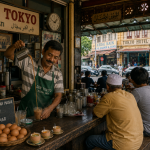
I am having breakfast at Din Tokyo — a name that has always intrigued me. Not in the old building, though. That one stood next door, long gone from its former glory. This visit was unplanned. I found myself here while waiting for my wife, who is at a school co-curricular activity. The morning is still early, and the shop is not yet bustling. Many tables sit empty. I choose a spot inside, at the far end near where the drinks are prepared.
I have eaten here before, years ago. Comparing then and now, I find this place has lost its lustre.
It used to be something special — what we Kelantanese call a kedai pati, from the English word petty, meaning small. In those days, customers sat on long wooden benches arranged around a central figure: the man who made the drinks and half-boiled eggs. That man was Abe Din, a middle-aged owner with a handsome face, a thick Tom Selleck moustache, and a voice as warm as the tea he poured. He was the heart of the shop, the centre of attraction. He did not just make tea — he entertained. He talked to his customers like old friends. And he was a clever marketer. He introduced and branded different types of half-boiled eggs according to how hard they were cooked: ping pong, Taliban, Misyar Omar. I have never tasted better half-boiled eggs in Kota Bharu. I do not think that is an exaggeration.
The name Din Tokyo always puzzled me. At first, I assumed Abe Din must have lived in Tokyo or had some connection to Japan. Later, I learned the truth: his shop was once located near the former Tokyo Hotel — a landmark I never knew existed in Kota Bharu. Perhaps only the older generation or those who stayed long in the city would remember it.
I came not just for the eggs. I came for the warmth of Abe Din's greeting and the unique vibes of the place. Customers from all walks of life sat shoulder to shoulder — no walls, no pretence. The shop was so popular that it was featured in Going Places, the in-flight magazine of Malaysian Airlines. I heard that visitors from outside Kelantan, upon arriving in the state, would make Din Tokyo their first destination.
Once in a while, I would meet my friends there, or students from Universiti Malaysia Kelantan. It became our meetup place, tucked at the fourth junction of the defunct Temenggong Hotel. We would park along Temenggong Road and walk in.
But at the peak of its success, Abe Din decided to return to his village somewhere in Narathiwat, Thailand. He handed the shop over to his sister-in-law. After that, the kedai pati concept died. The shop moved next door, and the new layout became that of an ordinary restaurant. They kept a long wooden bench near the drink preparation area, but it is too small now. Drinks are placed there for waiters to grab, and no customer truly sits there anymore.
I miss what it was. No longer can I see Abe Din, that affable man, standing in the middle, making hot and frosty tea for me. No longer does his beautiful voice welcome customers and chat with them like old friends. Gone are the best half-boiled eggs I ever had in Kota Bharu.
Sometimes I stayed longer just to watch my surroundings and soak in the shop's vibes. As someone who lived away from Kota Bharu for many years, returning to taste the remains of my past felt like a blessing. But those who never left — they do not feel what I feel. That ache, that quiet gratitude. Only those who have left Kelantan understand.
At Din Tokyo, I found my lost treasure: a time when life was not rushing, when I could soak in the laid-back environment of Kota Bharu, the capital of Kelantan.
The Kedai Pati Tradition
Din Tokyo was just one example. Across Kota Bharu, the kedai pati tradition still lives.
Compared to other states in Peninsular Malaysia, Kelantan — situated on the border with Thailand — is unique. Many things we do there cannot be found elsewhere. Several kedai pati concepts are still operating. Popular ones include Kedai Pati Ayub, Kedai Milo Tunggeng, and a few others I visit without knowing their names.
Why is the kedai pati concept so popular in Kelantan?
First, the variety of food. You name it: different types of packed rice, kuih, satay, hard-boiled and half-boiled eggs. These shops typically do not cook or prepare dishes themselves. They take commission on items sold.
Second, the open-door concept. No walls. No windows. You can see everything happening around you. While sipping tea, you watch cars pass by and people crossing the road. You do not sit hidden behind walls.
Third, transparency. You see how your drink is prepared, right in front of you. Hot water poured over tea leaves, swirled in a glass. The half-boiled eggs made on the spot. The high wooden benches resemble bar stools. I believe kedai pati was first introduced as a modification of a Western bar — adapted to suit local tastes then, and still now.
Fourth, affordability. Prices are far cheaper than other food shops and restaurants. Many customers come from the B40 group, yet people from all walks of life frequent these shops.
Not all kedai pati are owned by ethnic Malay Kelantanese. One on Jalan Langgar is run by Indian Muslims. It has stood there for many years, serving hundreds of customers daily.
Kedai pati is part of the rich tapestry of Kelantanese culture — evolved over time, cherished by those who leave, and sometimes taken for granted by those who stay.
How long will these shops remain in Kota Bharu and Kelantan? Nobody knows. With the influx of modern lifestyles, younger generations prefer cafes and malls — more convenient, private, and clean. Some feel uncomfortable sitting with strangers or with those who smoke after eating.
Yet I personally believe the kedai pati concept is here to stay. At least for the near future. And Kota Bharu, I hope, will maintain its charm.