Travelling to Brunei, in truth, was my gift to myself—a deliberate pause. My fieldwork schedule in Peninsula Malaysia and Sarawak had been intense, filled with a lot of travelling and the weighty conversations of palm oil companies, non-governmental organisations, and environmental advocacy organisations. I felt the fatigue in my bones and mind. Since I had never been to Brunei and I was already in Miri—a mere 150 kilometres, about two to three hours from Bandar Seri Begawan—the opportunity felt like a sign. It was a chance to step sideways out of my research role, if only for a few days. I reasoned that a short detour into a quiet sultanate would allow me to reset, recharge and revive. I could wander without an agenda, observe a different pace of life in the Malay Sultanate, and return to my following interviews in Sabah with feeling refreshed and mentally clear. I mentioned my plan to a friendly local man who worked at a backpackers’ hostel. He offered to help, explaining that he knew someone from a newspaper delivery lorry that daily crossed into Brunei every morning and that he could arrange for me to ride along. Grateful, I agreed, and he successfully arranged my journey. He told me to be ready in the very early morning the next day, and I went to sleep imagining a bumpy ride on the back of a newspaper lorry.
The next morning, while other people were still sleeping, I waited outside in the cool, grey dawn. The street was quiet. I waited and waited. But no lorry appeared, just as I began to doubt the plan. Around 7 a.m., a metallic-coloured SUV pulled up. A pleasant-looking young Chinese woman rolled down the window, confirmed my name with a quick smile, and told me to get in. She drove through Miri's streets, picking up two more young Chinese women at different locations. Women are curious about others!. They asked about me and my business in Brunei. I told them I was a PhD student in Australia, doing fieldwork in MIRI, and that I would visit Brunei for the first time as a holiday, then would continue my journey to Kota Kinabalu, Sabah. That information broke the ice and suspicion, and we exchanged views, their chatter and laughter filling the car. I was a thorn among the roses. The distance between the backpackers to the border is around 40 kilometres, seemingly less with a good companion.
When we reached the Sungai Tujuh Immigration Checkpoint, the lady’s driver and her friends' approach was effortlessly relaxed. They greeted the Malaysian immigration officer, exchanging warm and familiar banter. It was clear they knew each other quite well. When I handed over my passport, the officer barely glanced at it, too engrossed in his friendly conversation with the lady driver and her friends. With a quick stamp, I was through, the entire process feeling more like a social call than an official procedure. The same thing repeated at Brunei immigration. As we drove further into Brunei, the conversation revealed that she and her friends jointly operated a salon in Bandar Seri Begawan. They were crossing every weekday for work. The journey through Tutong Highway was smooth, and the company lively. She dropped me off right in front of the Youth Centre, my budget sanctuary in the capital of Brunei. I gave her RM50 for the ride, as I was told earlier. With a wave, they drove off, leaving me on the sidewalk, slightly amazed at the serendipity of it all. What began as a failed plan for a newspaper lorry ride had turned into a smooth, friendly passage, all thanks to the informal network of daily life and a kind stranger with a SUV.
Youth Centre is a government-run hostel, which is the very definition of no-frills, practical travel. This hostel is intended for young citizens and international youth organisations, but it famously opens its doors to budget-conscious travellers of all ages. With the fee of B$10 (Brunei Dollar) per night, I stayed in the cheapest accommodation in one of the world's wealthiest nations. The hostel is housed in a large, blocky, and utilitarian multi-story building that speaks more of function than charm. Its architecture is straightforward 1990s public-use style, with clean lines and a no-nonsense facade. The atmosphere inside is quiet, institutional, and orderly. The common areas are often hushed, with guests keeping to themselves or quietly planning their itineraries. My room had simple, sturdy bunk beds with a thin mattress, a well-worn but clean pillow, and a blanket. A small locker or space to store my bag, a bare floor, fluorescent lighting, and an overhanging ceiling fan. Shared bathrooms and showers, located on end of each floor. They are typically wet-room style—basic but usually kept clean through regular maintenance. Like other hostels in Malaysia, the sound of shower doors and early-morning routines were part of the shared experience. Besides the price, its strategic location was the reason I chose to stay here. Situated in the heart of Bandar Seri Begawan, it places me within walking distance or a short bus ride from the city's major sights: the majestic Omar Ali Saifuddien Mosque, the sprawling Gadong Night Market for local food, and the Water Village (Kampong Ayer). It functions as a perfect, neutral base camp—a cool, cheap place to sleep and reorganise after a day of exploring the serene, oil-rich sultanate.
I hit the ground running and walked along the Kianggeh Road to a supermarket to get the necessary items. Shopping in Brunei was much like in Australia, with grocery prices about the same. After a quick buy, I had lunch at the nearby shop. I ordered a plate of fried rice and a glass of Teh Tarik. The food was delicious, and a hot piping teh tarik was absolutely heavenly, the perfect way to end my meal. As I handed over B$1.50 for a plate of fried noodles and 50 cents for a glass of teh tarik, I was struck not just by the affordability, but by a deep sense of familiarity. The numbers felt like a key, unlocking a memory from a different era. In my mind, I was suddenly back in Kelantan in the 1980s, where similar prices would have bought a similar simple, satisfying meal at a warung by the roadside. The cost, in its own way, was a gentle echo of a time when life felt measured in ringgit and sen, not in grand ambitions. It was a quiet, comforting throwback — finding the value of my youth in the present-day economy of this wealthy sultanate. This feeling of stepping into a familiar past continued during my strolls through the quiet commercial lanes of the City Centre near the Brunei Waterfront. Alongside shops selling electronics and fabrics, I noticed a series of small tailoring shops. Inside each, bathed in the glow of a single fluorescent light, sat tailors—mostly Indian men—deep in concentration behind their vintage sewing machines. The rhythmic whirr and tick-tack-tick of the machines spilt out onto the sidewalk. Bolts of cloth for baju kurung, school uniforms, and suits stood neatly against the walls. It was a scene of quiet, skilled craftsmanship that felt timeless, a niche preserved by a community that had made this place home. The sight, paired with the taste of those cheap, delicious noodles, painted a picture of a Brunei that was not just about oil wealth and luxury cars, but also about these enduring, humble economies of daily life and necessity.
In the late afternoon, I sat quietly, with an empty plate on the table, in the open food court by the bank of the Brunei River, as the fierce afternoon heat softened into golden hour. Following the table, an expatriate, perhaps from Europe, had a meal with his family. This was my last evening in the Malay Sultanate, once a major empire that held sway over the vast kingdom as far as the Southern Philippines; now it is only a tiny country. I watched life go by on the water: the sleek, fibreglass boats, their engines puttering steadily, carving lines across the calm surface as they ferried residents of Kampung Ayer to the main jetty and back home. It was a rhythmic, endless shuttle, the lifeblood of the water village. Then, the sky began to perform. The sun, a vast, burning orb, started its descent. It painted the heavens in strokes of orange, rose, and deep purple, the colours reflecting perfectly on the glassy water. I watched one boat, silhouetted against this brilliant canvas, make what felt like the last ride of the day, its wake shimmering in the dying light. The scene was profoundly peaceful. As the light faded, I was approached by a young, affable young Bruneian man. He smiled and said, "I saw you standing here. I instantly recognised you were not a local." We laughed about the obvious. In a gesture of pure hospitality, he then offered, "Come, I will give you a lift. Let's go pray Maghrib at the floating mosque." Gratefully, I accepted. We drove to the Sultan Sharif Ali Mosque as the last of the sunset glow clung to its white domes and golden spires. To pray Maghrib there, in that serene, majestic space I had visited before, but now in the quiet of twilight, felt like a special blessing. After the prayer, I looked out from the mosque's platform over the darkening water of the Brunei River. I called it a day and went back to the hostel.
The next day, a tall, middle-aged hostel staff member came to visit me one morning after learning I was from Kelantan. He wanted to know more about politics in Kelantan in particular, and he wanted to hear it from me rather than rely on the news. We chatted for almost one hour. Later, I walked to the Bandar Seri Bagawan Bus Terminal to catch a bus to the University Brunei Darussalam (UBD). Rattling along in the humble minibus, I moved beyond the city centre into Brunei's residential heartlands. The view from the window revealed a landscape of orderly, spacious living. The houses were a distinct modern evolution of traditional architecture: raised on sturdy concrete stilts, creating a shaded carport beneath for the family's vehicles—often a sedan or an SUV. This design spoke to both practicalities, such as better ventilation, preparation for occasional floods, and prosperity. There was a striking openness to the neighbourhoods. No high walls or fences divided the properties; instead, low, manicured hedges, flowering shrubs, or simply a mown strip of grass acted as gentle, symbolic boundaries. This lack of barricades conveyed a powerful sense of community safety and social trust. The homes were universally well-maintained, with clean lines, fresh paint, and satellite dishes. The thought that crossed your mind—"Their houses are better than what we got at home"—spoke to the visible, widespread comfort afforded by the nation's wealth, distributed across its small population.
My visit to the Universiti Brunei Darussalam (UBD) campus, with its sprawling, modern architecture and serene lake, must have offered a fascinating glimpse into the nation's academic heart. I went to the Faculty of Business, Economics and Policy Studies (FBEPS). Inside the building, I read information on the notice board and photos of lectures and their specialities, and went to the upper floor, where I asked a staff member at the administrative office to meet the dean, but I was told he was not around. It was a semester holiday; no wonder the faculty was without students and lecturers. However, the tranquillity evaporated when I returned to the bus stop, only to find the schedule was either sporadic, had ended for the day, or was simply unclear for the return leg to the city centre. As the afternoon sun beat down, the well-ordered campus felt suddenly isolated. With few options, I made my way to the main highway—the Muara-Tutong Highway—a busy artery connecting the city to its outskirts. The feeling was one of vulnerability: the roar of passing cars and the growing realisation that I was at the mercy of chance. I decided to walk off the campus to the highway, raising my arm and extending a tentative hitchhiker's signal—a universal gesture of need. In a nation where private transport reigns and hitchhiking is uncommon, I couldn't have predicted who would stop as I waited for ten minutes. I nearly lost hope.
A kind-faced Bangladeshi man drove the old white sedan that pulled over, likely one of the many foreign workers who form the backbone of Brunei's service and construction sectors. His expression was one of concern, not judgment. I slid into the passenger seat, explaining your predicament and my destination - Wisma Belia. The drive back was a quiet journey of gratitude. The golden dome of Omar Ali Saifuddien Mosque, glinting in the sun, grew larger and more welcoming. When I finally arrived at the familiar, blocky facade of my B$ 10-a-night hostel, the sense of relief was immense. It was more than just a building; it was my anchor, my safe point in the city. In a gesture of deep thanks, I offered him a 20 Brunei dollar note. His reaction was humble and telling. He shook his head, a slight smile on his face, insisting it was too much. He said B$10 was enough, not as a transaction, but a genuine help. This small act of refusal spoke volumes about dignity and camaraderie, a moment of human connection that transcended races and nationality. I was deeply moved by his help and wished him all the best. He drove off, and I stood there in front of the Youth Centre, the day's anxiety melting away. The hostel, with its Spartan dormitories and shared bathrooms, had never felt more like a sanctuary. That evening, the simple comforts of my budget bunk—the thin pillow, the hum of the ceiling fan —were all I wanted in this world: a peaceful time to relax in bed.
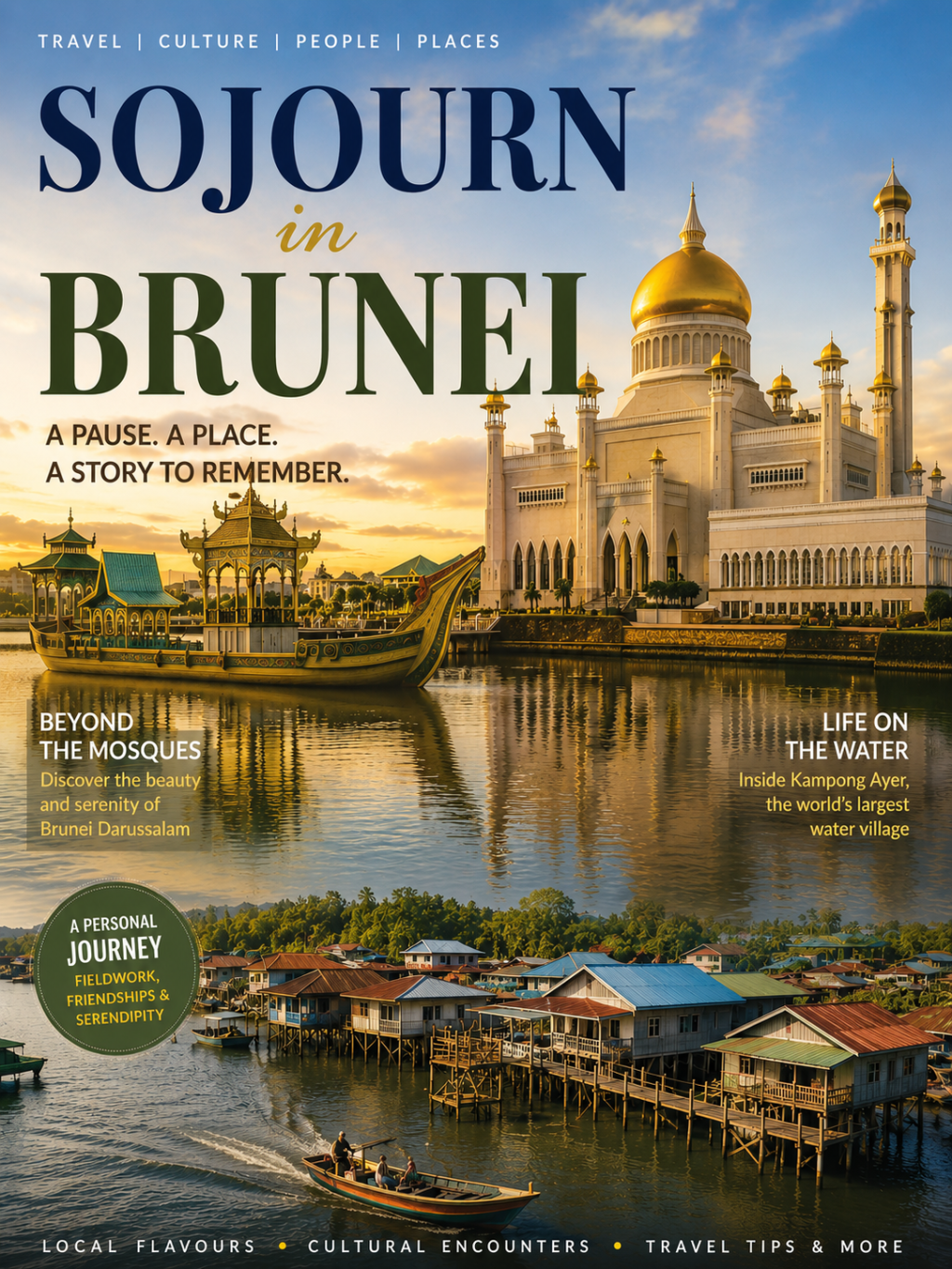
My Jumaat prayer, a compulsory weekly prayer for male adults at the magnificent Sultan Sharif Ali Mosque, often called the "Floating Mosque" for its stunning perch over the Brunei River, was a highlight. Its grand, golden domes and pristine white walls gleamed under the sun. The serene atmosphere inside, filled with devoted worshippers, was a moment of profound peace. The parking lot outside, however, told another part of Brunei's story: it was lined with luxury cars—Mercedes, BMWs, Lexuses, and Range Rovers. Any brands of expensive cars you can imagine. This silent display was a direct testament to the country's oil and gas wealth, a tangible sign of the prosperity that fuels this nation of just over 400,000 people. Later, I descended into the watery labyrinth of Kampung Ayer, the "Water Village." Reaching it by a quick, breezy boat ride across the muddy bay, the city's modern buildings instantly gave way to a centuries-old world. This wasn't a museum exhibit; it was a living, breathing town on stilts. A maze of wooden walkways connected thousands of homes, schools, mosques, and shops, all standing above the tidal river on tall pilings. The boat weaved through quiet residential canals and bustling main waterways, the young Malay driver expertly navigating. I disembarked at a cluster that included food shops, but they were still open as I was pretty early. I approached a young woman who was busied at work, peeling garlic and cutting vegetables for the ingredients of food. Sitting down for a plate of fried noodles, I was immersed in the rhythm of the village. The unique sound of the lapping of water against poles, the putter of passing penambang (water taxis), children's laughter echoing from a balcony. The air carried mingled scents of the river, frying food, and tangy sea breeze. While traditional in appearance, you could see modern cables snaking along the walkways, bringing electricity, clean water, and internet to this historic community. It was a profound experience, showcasing Bruneian resilience and identity, standing literally and figuratively between its majestic past and its sleek, oil-funded present.
My day perfectly captured the Brunei paradox: the ultra-modern convenience witnessed in the suburbs and the mosque parking lot, existing side-by-side with the enduring, communal traditions of Kampung Ayer, all underpinned by the quiet, devout faith you participated in at prayer time. My quiet ritual of reading the local papers offered a unique window into the nation's soul. Each morning, I would pick up the two leading dailies: the Borneo Bulletin, in English, and Pelita Brunei, often referred to as Media Permata, in Malay. The first thing I noticed was their physical heft—or lack thereof. They were pretty thin, especially compared to the dense, multi-section newspapers I was used to in Malaysia. This thinness spoke volumes: of a smaller population, a more concentrated news cycle, and perhaps a media landscape that was curated and concise. Beyond the expected sections on government directives, business, and education, a particular type of story consistently caught my eye. Alongside reports on royal ceremonies and school competitions, both publications regularly carried brief, celebratory announcements about local Chinese Bruneians converting to Islam. These were often accompanied by small photographs of the individual or family, smiling, sometimes holding a copy of the Quran. The tone was always one of warm community welcome and spiritual milestone.
Reading these reports in the quiet of a hostel standard room or a coffee shop added a profound layer to my understanding of Brunei. It wasn't just news; it was a subtle narrative of national identity and religious harmony. In a nation defined by its Malay Islamic Monarchy ethos, these stories highlighted a personal, voluntary journey into the country's spiritual and social fabric. The thin newspapers, it turned out, carried weighty stories—not of conflict, but of quiet integration and faith, mirroring the serene and orderly society I was moving through outside. News about Malaysia always appeared on both newspapers. Since I didn’t want to take unnecessary risks with delays, I checked out early in the morning and took a taxi to the ferry terminal. The journey took about 30 minutes, as not many vehicles, and the route was straightforward, following the well-maintained Muara-Tutong Highway directly to the coast. The Muara Ferry Terminal, which is located specifically in the Serasa area of Muara, is approximately 25 to 30 kilometres northeast of Bandar Seri Begawan's city centre. It felt orderly and quiet in the early morning light. The building was modern and clean, with a sense of hushed efficiency. The air was still cool, carrying the faint, salty tang of the Brunei Bay. The sky was a soft, pale blue, streaked with wisps of high cloud, promising the heat to come. The sea here was calm, almost lake-like, with gentle, oily swells that barely rocked the moored ferries. The ticket counter just opened, and I bought the ticket to Labuan for the morning departure.
Boarding the sturdy, multi-deck vessel, there was a sense of anticipation; you were leaving the compact serenity of Brunei for the bustling maritime crossroads of Labuan. As the ferry pulled out, the water deepened from green to a profound blue. The initial calm gave way to the open waters of the South China Sea. Here, the waves developed a rhythm—long, rolling swells that caused the ferry to rise and fall in a slow, predictable motion. The sky stretched vast and cloudless, the sun reflecting off the water in a blinding, shimmering path. It was meditative, but the constant, deep-heaved movement of the ship began to take its toll. About an hour in, a young woman a few rows ahead succumbed to the relentless sway. Her discreet struggle was lost to the engine's drone, but her sudden lurch and the hurried reaching for a bag were a universal language of distress. A crew member moved quickly with a discreet plastic bag and a word of sympathy, a small drama of human vulnerability against the indifferent sea. The journey took 3 hours, and we arrived at Labuan Island around noon.
Disembarking at Labuan Jetty was a sensory shock. A humid cacophony replaced the orderly silence of Muara—blaring dock machinery, shouts from porters, and the dense, hot air. The jetty itself was functional and weathered, smelling of diesel, salt, and dried fish. Directly outside, I noted, a row of shops spilt out with vibrant Indonesian sarongs and clothing, a splash of maroon, batik blue, and gold against the concrete. But I was quite worry if the custom would confiscate them upon checking. Sensing I got something to bring back to Kelantan, I went to the Labuan Central Market. The cool, dim interior and the pungent, briny aroma of seafood greeted me. Strolling around, I had the friendly banter with the woman from Pasir Puteh where her husband worked with the firebrigate department in Labuan, her Kelantanese accent a familiar melody so far from home, culminating in that prized, discounted packet of Gelama salt fish. Later, at the Victoria Point Duty Free Shop, the climate-controlled chill and the gleaming aisles of imported chocolates, amber spirits, and perfumes felt like a separate, surreal world, which I passed through like a ghost, my mind still on the market and my bag holding the salty treasure. That kind of salty fish also available in Kelantan, buying it just impromptu action of a short visit. Re-boarding a different ferry on a hot, sunny afternoon, the heat was stifling. The sea on this leg seemed different. The waves were choppier, kicked up by the afternoon winds, causing a sharper, less predictable pitching. The sun was now intensely hot and bright, heating the deck and making the interior cabin feel stuffy. The journey felt longer than its two hours; fatigue set in after the day's travels. This leg was less about sightseeing and more about endurance, the majestic view of the coast of Sabah gradually growing on the horizon, offering the only relief.
Finally, the Kota Kinabalu jetty appeared, a welcome sight of a bustling terminal. This was the largest and most chaotic of the three—a gateway to a significant city. Ferries, speedboats, and fishing vessels jostled for space. Outside the terminal, alive with the shouts of taxi touts, families reuniting, and the general clamour of arrival, the air was thick with exhaust. The sea here, protected in the bay, was a busy, choppy turquoise, dancing with the reflected lights of the city as the day began to wane. It was the longest ferry ride of my life. It took the whole day to travel from Brunei to Sabah. Actually, it's not just in hours, but in experience—from the calm dawn of Brunei, through the human warmth and commercial buzz of Labuan, across the demanding, sun-beaten waves of the open sea, and finally to the vibrant chaos of Kota Kinabalu. The sky had transformed from a soft morning canvas to a dome of fierce afternoon heat, and the sea had shifted from gentle swells to assertive chops. It was a marathon over water, a day defined by the hum of engines, the smell of salt and diesel, a moment of shared human frailty, and the simple, satisfying weight of a packet of salt fish, connecting one coast of life to another.