The words stayed with me for days.
As academics, professionals, leaders, and employees, many of us spend our lives chasing achievements. We work hard to earn promotions, awards, certificates, and recognition. We proudly frame our accomplishments and celebrate milestones throughout our careers.
There is nothing wrong with that.
Achievement gives us purpose. It motivates us to grow and contribute. However, somewhere along the way, many organizations have become so focused on outcomes that they forget the people responsible for producing them.
Behind every KPI is a human being.
Behind every report submitted before the deadline is someone who may have stayed up late to complete it.Behind every successful project is someone who may have sacrificed weekends, family time, personal health, or peace of mind.
Yet these sacrifices often go unnoticed.
Many employees do not mind working hard. In fact, most people derive satisfaction from meaningful work. They want to contribute. They want to make a difference. They want to be part of something bigger than themselves.
What hurts is not the workload itself.
What hurts is when the workload keeps increasing while appreciation remains absent.
What hurts is when additional responsibilities become expectations rather than opportunities.
What hurts is when leaders continue asking for more without asking whether their people are coping.
I have often heard managers say, "We need everyone to go the extra mile."
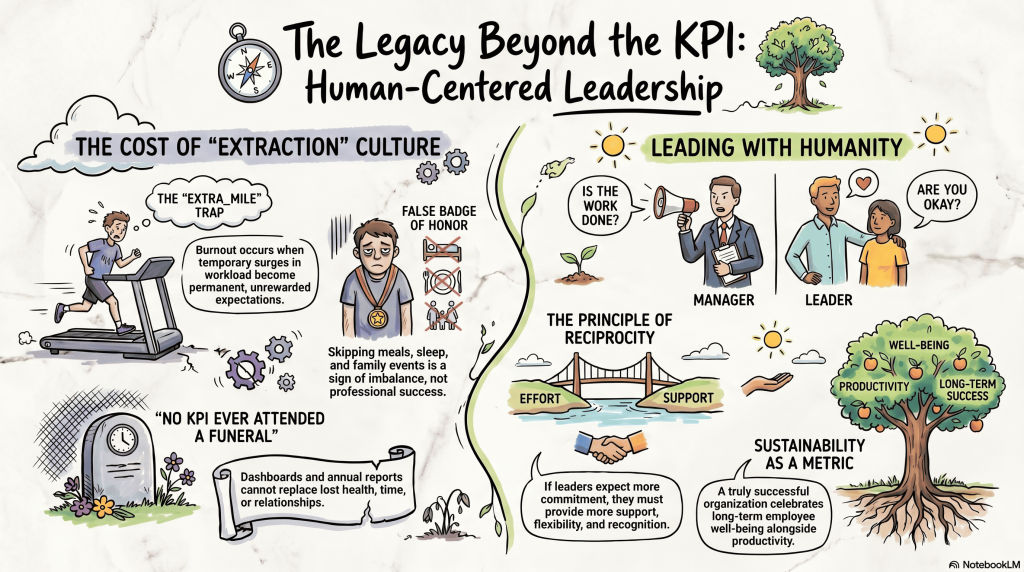
There is nothing wrong with going the extra mile occasionally. The problem arises when the extra mile becomes the normal route. Soon, one person's job becomes two people's jobs. Then two become three. More meetings are added. More reports are required. More committees are formed. More expectations are introduced.
Yet the rewards, recognition, and support remain exactly the same. At some point, even the most dedicated employee begins to feel exhausted.
Not because they are weak.
Not because they lack commitment.
But because they are human.
One of the greatest misconceptions in leadership is believing that people can continue giving indefinitely without receiving anything in return. Every healthy relationship is built on reciprocity. The same principle applies to organizations. If leaders expect more commitment, they must provide more support. If leaders expect employees to stretch themselves further, they must create opportunities for growth, recognition, flexibility, and well-being.
Not every reward has to be financial. Sometimes people simply want to feel seen. They want their efforts acknowledged. They want leaders who listen. They want to know that their sacrifices matter. Unfortunately, many workplaces have become environments where exhaustion is worn like a badge of honor.
People proudly speak about working until midnight. Responding to emails during holidays. Skipping lunch. Missing family events. Sacrificing sleep. As if suffering is proof of commitment. But perhaps we should ask ourselves a different question.
When did being constantly tired become a measure of success?
A truly successful organization should not only celebrate productivity. It should also celebrate sustainability. After all, what is the point of achieving exceptional organizational performance if the people responsible for that success are quietly burning out?
This is where leadership matters.
Managers manage tasks.
Leaders care for people.
A manager asks whether the work has been completed. A leader asks whether the person completing the work is okay. That small difference can change an entire workplace culture.
Today, we hear more stories of employees leaving organizations that once seemed attractive and stable. Some people describe this as a lack of resilience. Others blame changing generational attitudes.
I see it differently.
Many employees are no longer leaving because they dislike hard work. They are leaving because they no longer wish to sacrifice their well-being for environments that do not value them.
Sometimes resignation is not an act of rebellion. It is an act of self-preservation. As leaders, perhaps it is time we pause and reflect. Are we developing people or merely extracting labor? Are we creating workplaces where individuals can thrive, or places where they simply endure? Are we measuring success only through numbers, or also through the well-being of those producing those numbers?
These are uncomfortable questions, but they are necessary ones.
Because at the end of the day, no KPI has ever attended a person's funeral. No performance dashboard has ever comforted a grieving family. No annual report has ever replaced lost health, lost time, or lost relationships. Yet people often sacrifice all of these in pursuit of organizational goals.
This is why leaders must be careful not to continuously push employees to do more without providing meaningful support, recognition, and reward. Otherwise, we risk creating workplaces where people give everything they have until there is nothing left to give.
And when that happens, all the certificates of achievement, all the awards, and all the performance indicators suddenly seem far less important. Because no matter how many KPI certificates we accumulate throughout our careers, there is only one certificate that every one of us will eventually receive.
A death certificate.
Perhaps that reality should remind us that while performance matters, people matter more. The most important legacy of any leader will never be the targets they achieved. It will be the lives they touched, the people they uplifted, and the humanity they preserved along the way.