The winter dark hadn’t yet lifted when I left Platt Hall. The air bit at my cheeks, my breath clouding in the streetlamp’s orange glow. The walk to Colindale tube station was short but felt longer, my rucksack light but my expectations were heavy. The station itself was nearly empty—just a few early souls, faces buried in scarves, waiting without speaking. I have been in the UK for a few months.
The Northern Line train arrived with a tired hiss. Inside, the carriage was fluorescent-lit and rattling, windows steamed from the cold outside. I sat by the door, watching the tunnels flash between stations: Hendon, Brent Cross, Camden, Hamstead, the names drifting past. Gradually, the train filled as we moved south, but no one sat next to me. In 1995, on a winter weekend morning, London was still half-asleep. In central London, I changed lines—escalators and tiled corridors—and made my way to London Victoria station. I learned in London, especially, that the basic living skills were using public transportation, and the most important one was the London Underground or Tube. The departures board clicked over to show the early train to Dover Priory. I found my carriage, cold and nearly empty, and settled by a window.
The train eased out of the shed, past the back gardens of Pimlico, then into the open Kent countryside. Frost lay in the fields' hollows. The suburbs gave way to bare trees and pale winter light. Then the announcement came: Bromley South. The train slowed. I looked out at the platform—ordinary, brick-edged, a few waiting passengers. And suddenly, unexpectedly, a memory struck me with full force. During my early teenage years in secondary school in Kelantan, I used to play a cassette of Suhaimi Meor Hassan, a famous Malaysian singer and songwriter. One song I played over and over was "Epilog Cinta dari Bromley" —Love Epilogue from Bromley. I had never understood why Bromley—such an English, suburban name—appeared in his lyrics. But there, as our train stopped, I saw in my mind’s eye his picture album. In that photograph, he was wearing a thick hooded shirt over jeans, sitting on a wooden fence of natural wood colour in a quiet suburban area, his face calm and slightly distant. The image flashed vividly: the fence, the bare branches behind him, the grey English sky. It was as if he had been here, in this very landscape, long before me. The melody of that song hummed faintly in my head as the train waited at the lonely platform.
The train pulled away from Bromley. Soon, the line began to rise and fall through the Kent Downs. We passed through several short tunnels—sudden plunges into darkness, the carriage windows turning into black mirrors for a few seconds, then bursting back into winter light with a rush of air. Each tunnel felt like a small adventure, a blink of the earth’s eye. I counted four or five of them, their brick mouths lined with dripping ivy. Between tunnels, the sea began to appear in flashes. The travel distance was roughly 110 kilometres, and the train journey took almost 2 hours.
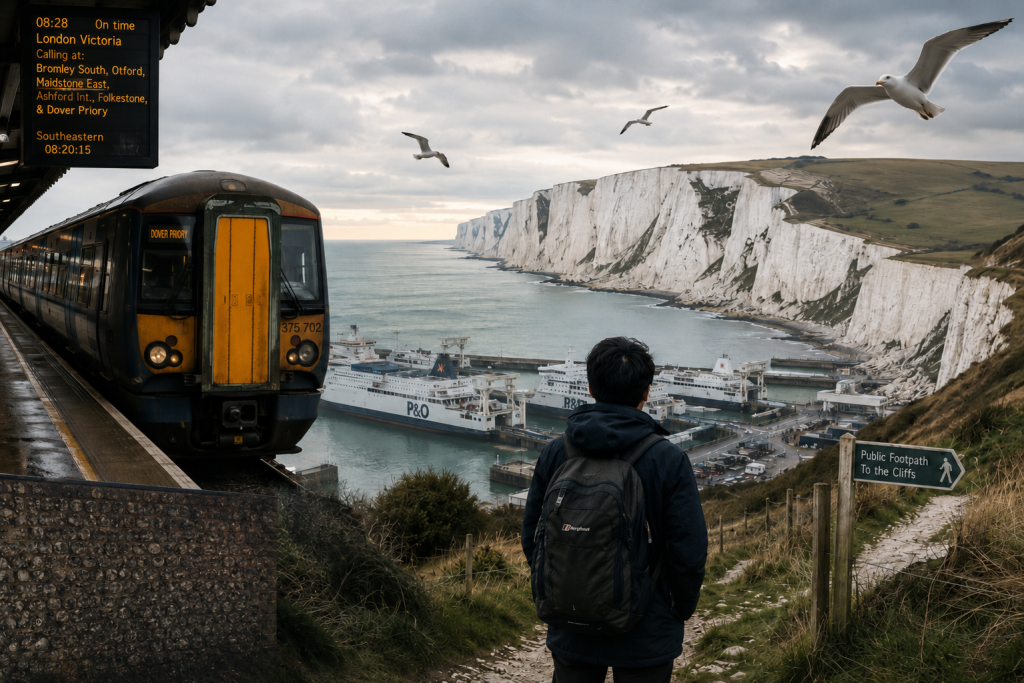
Then the first silver glint of the Channel steadied on the horizon. Dover Priory station was brisk, the wind already cutting through the platform. I didn't set off on foot straight away. Instead, I found the bus stop just outside the station and caught the number 15 bus. It was a short ride—no more than ten minutes—taking me past the streets of Dover and up towards the base of the famous cliffs. The bus dropped me off at the foothill, saving my energy for the climb ahead.
Before heading up, though, I walked toward the harbour. From the seafront, the sound of Dover’s busy port was immediate and industrial: the low, throaty honk of ferries reversing or signalling, the clank of mooring chains, and above all, the sharp, laughing cries of seagulls wheeling in the grey sky. I stopped and watched large white ferries docking—their massive bows nosing into the harbour, white paint stark against the green-grey water. They looked like moving buildings, carrying passengers and lorries across the Channel to France. For a moment, I imagined the journey continuing beyond the cliffs.
But I had come for the cliffs themselves. As a geography student, I studied geomorphology: coastal erosion, differential weathering, and the sheer vertical drop of chalk where the North Downs meet the sea. The idea of seeing the white cliffs in person first came from a book I read during my student time at University Malaya — a coastal geomorphology book with a black-and-white photograph of the Seven Sisters (or similar chalk cliffs). I can’t recall the title now, but that image planted the seed. In my mind, I had pictured the cliffs many times. Now I would like to see them.
From the foothill, I began to climb. The ladder path was chalk-dusted and slippery in places, the grass thin and winter-bleached. The wind grew stronger with every step. And then, partway up, I saw something that moved me. An old homeless man stood outside a small, cluttered shed. The shed was patched with bits of wood and plastic, surrounded by piles of rubbish, old blankets, and rusted metal. The man himself was tall and lanky, wrapped in a frayed coat that looked too light for the cold. His face was weathered, his hands shoved deep into his pockets. He wasn't begging or even looking at me. He just stood there, staring at the ground, as if waiting for something. I was afraid because I was alone, so I quickened my pace.
Before coming to the United Kingdom, many of us back in Malaysia thought this country was a land of milk and honey—a place where everyone lived comfortably, where the streets were clean and the people prosperous. We saw the pictures in magazines, the films, the stories of opportunity. But here, on a frozen winter morning in Dover, I was confronted with a different truth. Here, I came across a tall older man, living in a cluttered shed on the hillside—how did he survive on cold winter days and nights? Where were his milk and honey? I couldn’t imagine it. They stayed with me as I turned away and continued climbing.
I was on top of the white chalk cliff. The wind was ferocious—a clean, salt-laden roar that stole sound and left only space. The chalk itself was dazzling, so white it seemed to glow against the pewter Channel. The cliffs dropped sheer below my boots, a vertical face of creamy rock plunging into the churning waves. Far below, the sea gnawed at the base, undercutting the rock in the classic geomorphological pattern I had traced in the book back at the Universiti Malaya’s library.
And that was the other thought that struck me. At home, on the east coast of Malaysia, our beaches are flat, long, sandy, gentle shores where the South China Sea laps without drama. Only a few cliffs meet the sea there; overall, it is a slow, horizontal meeting of land and water. But here, in Dover, the land rose up and then ended. Vertically. A wall of ancient marine sediment, once laid down at the bottom of a warm sea millions of years ago, is now exposed to the cold waters of the English Channel. The geographer in me was thrilled; the traveller in me was humbled.
I stood for a long time. The gulls cried overhead, riding the updrafts. Below, the port honked its deep ferry calls. A white ferry slipped out of the harbour, heading toward Calais. Only a few people were on the viewing platform on the clifftop. There was a boy who used the binoculars and pointed them at Calais. When I asked if I could borrow it, he said no.
Then I lay down in that wiry, cold grass, my palms flat against the damp earth. I closed my eyes and listened: the waves breaking far below, the wind over my face, the distant machinery of the port. I stayed there for nearly an hour, feeling the damp seep through my coat, not caring.
But as the light began to soften from grey to a colder, thinner grey, I felt a familiar tug of reality. I wished I could spend longer on that grassy top of the cliffs—stay until the stars came out, until the ferries became strings of lights moving over the dark water. But I knew it was winter. The daytime was relatively shorter than in other seasons. The sun, already low and pale, would not linger. Soon, the path would be treacherous in the half-dark, and the trains back to London would grow fewer.
Reluctantly, I dragged my feet to descend. My heart did not want to leave. I turned my back to the sea with a physical ache, and began the slow, slipping walk down the chalky path, each step taking me further from that silent white edge.
That solitude, that clarity, that strange connection between a book I read during my student time at University Malaya — the black-and-white photo in that geomorphology book — a cassette song from my early teenage years in Kelantan, "Epilog Cinta dari Bromley", a natural wood fence under a grey English sky, the tunnels plunging through the Priory to the foothill, the image of that old homeless man outside his cluttered shed and the real white cliffs under my hands — it's all still with me, all these years later.