If someone asks me, why Padang in particular and West Sumatra in general are so special to you compared to other Indonesian cities and provinces that you have visited so far? There are several reasons for this preference: Firstly, this is the first city in Indonesia where I set my feet. In 2009, I accompanied a busload of students from UMK, and one of our purposes for the field visit was to conduct a preliminary study on entrepreneurship among the Minangkabau people. We managed to produce the paper for the national conference during the visit; subsequently, a chapter of a book was derived from that.
Secondly, similarly in terms of entrepreneurship, between Kelantan and Padang. When it comes to entrepreneurship, people in Indonesia always refer to Minang, and the same is true for Kelantanese in Malaysia. No other place I found entrepreneurial spirit and entrepreneurship firmly embedded and widely practised. Using the cases of entrepreneurs in Pasar Raya Padang and Pasar Khadijah in Kota Bharu, we identified several similarities between Kelantanese entrepreneurs and Minang entrepreneurs. Among other things, there is a strong presence of women entrepreneurs in both places, where they dominate businesses in the food, clothing, and textiles sectors. They also preferred to use internal sources to finance their businesses.
Thirdly, in terms of the uniqueness of the geography and geology of western Sumatra. While the city of Padang itself is a flat area that justifies its name, which in the Malay language means 'field', its hinterlands are hilly and contain a score of active volcanoes. Mount Singgalang and Mount Merapi are two of the most well-known volcanoes. During my previous visits, I could see that both of them were emitting smoke into the air, and on one occasion, I even saw it from the plane. I also found that it has two large crater lakes, Danau Maninjau and Danau Singkarak, which formed millions of years ago as rainwater and rivers filled these crater lakes. If you visit the former, you would come across 44 hairpin bends or turns. The beauty of the lake against the mountain background is indescribable.
Fourthly, the hospitality of the Minang people is unparalleled. Everywhere I visited, people treated me with kindness and respect. They are polite, friendly and show positive attitudes. No wonder their manners could easily move many.
Lastly, but not necessarily the least, is about Minang's food. They not only cook many dishes well but are also unique in their service and presentation. If you visit Minang's restaurant, there are up to 25 dishes on the table for you. Psychologically, they treat you like a rich person, with ample choices to try. My favourites are Ayam Pop, green sambal, or green chilli paste, and yellow coconut milk curry. They are irresistible.
Ranah Minangkabau is one of a kind; there is no other place in Sumatra, let alone in Indonesia, that can be compared to it in terms of uniqueness. The land, the weather, and the people blended well to create this idiosyncrasy, which was no surprise. Many visitors who come here would easily fall in love with it.
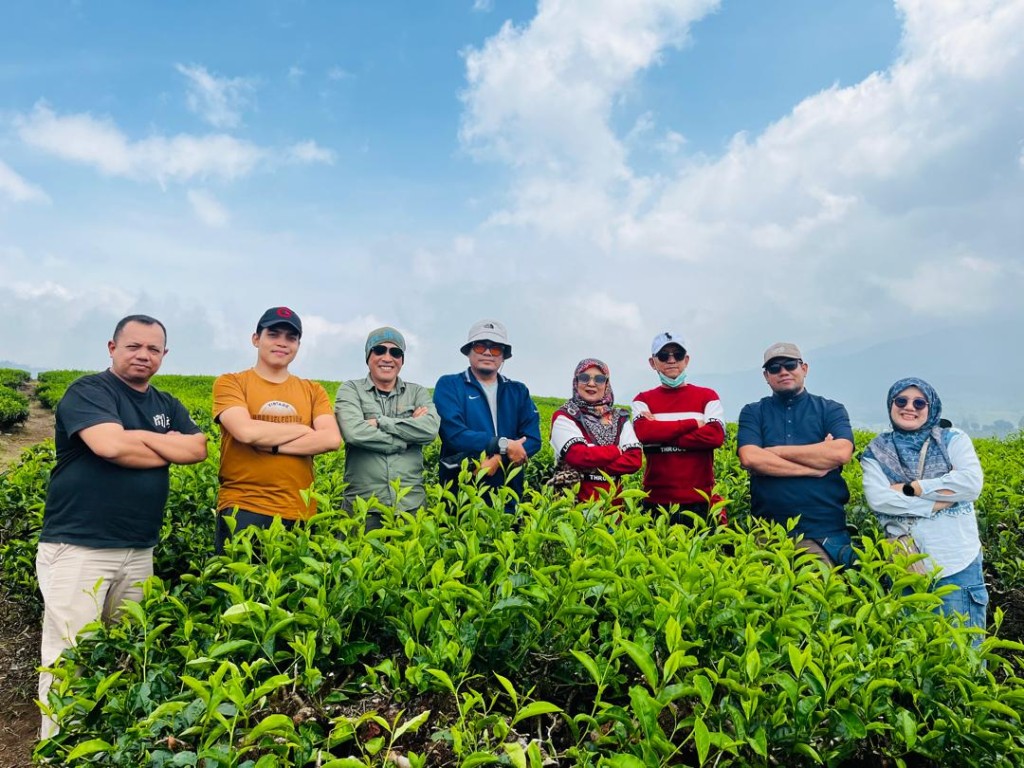
In Malaysia, the touristy Cameron Highlands is a favourite destination for many Malaysians seeking highland holidays due to its cool temperatures. I love visiting the Boh Tea plantation in Sungai Palas. While the road leads to Boh tea shop and its old factory is narrow and winding, we have no problem riding our car, as we know we will be rewarded with stunning views of the tea plantation while at the same time enjoying hot tea at its glass tea shop. Solok is the Cameron Highlands of West Sumatra. It is about 75 km from Padang. Due to its high altitude, averaging 523 meters, this place is particularly well-suited for vegetable cultivation, thanks to its favourable climate and fertile volcanic soil. The region's consistent rainfall, warm temperatures, and mountainous terrain create an environment conducive to growing a wide variety of vegetables. As with Cameron Highland, broad areas of tea plantation attract tourists from near and far. The tea plantation that stretches to the horizon, as far as the eye can see, is breath-taking. A visit to West Sumatra would not be complete without seeing the tea plantation in Alahan Panjang. As tea plants line your waist with grey mountains in the background and the sky above, it is a perfect shot for memorable photos. You need to ensure that you choose the right spots, poses, and expressions. The visit would be unforgettable.
While the current situation appears peaceful with the greenery of the tea plantation here, almost 200 years ago, fierce battles took place in Alahan Panjang when Tuanku Imam Bonjol, who led the Padri movement, and his warriors fought bravely against the Dutch colonial forces at his fortress. After a prolonged three-year siege, the brave imam's struggle was quashed, and he, like Pangeran Diponegoro, was exiled from Java; he was also exiled from Sumatra. First, he was sent to Cianjur in West Java, then to Ambon, and later to Manado in Sulawesi. He died in November 1864, at the old age of 92 and was buried on the island. The Dutch strategy against those who fought against its occupation in Indonesia was the same as what the British did in Malaysia; first, it divided the people and then suppressed and ruled them when they were weak. If you read about Imam Bonjol's history, you will find that two groups of Minangkabau fought against each other. The one led by Imam Bonjol wanted to introduce the correct version of Islam, but was opposed by another group who wanted to defend their non-Islamic culture. The latter asked for help from the Dutch, but later realised the Dutch had cheated them. But it was too late because the real enemy, whom they thought were friends, only wanted to suppress them.
His bravery and struggle against the invaders were not in vain, as the Minangkabau people fought for their country and gained independence in 1947. If you examine the Rp 5000 note from the 2000-2014 series, you will see the portrait of Tuanku Imam Bonjol. This is an effort by the government to appreciate the local hero. Furthermore, the Tuanku Imam Bonjol Monument in Puhun Tembok Village, Mandiangin Koto Selayan Sub-District, notes the struggle of Imam Bonjol. The imam tried to get rid of any barbaric and disgraceful acts done by the locals back then.
When we were just about to leave the tea plantation, from afar floated the noise of a van loaded with local trippers arriving at the area. Their face lit up as they got off the bus and looked at the greenery of the tea plantation. They would do what we did and leave the tea plantation after they had fulfilled their interests.
If you read the novel entitled "Tengelamnya Kapal van der vijck" written by Dr Hamka, a well-known novelist and Islamic scholar in Indonesia, Malaysia and other countries where Malays reside, he mentioned Solok as one of the places in Minangkabau where Zainuddin went to cheer up his heart after he received the news that his lover, Hayati, had agreed to marry Aziz, a guy from Padang Panjang. While Dr Hamka brought up Solok during his brief trip around West Sumatra, the beauty of Danau Berkembar, Singkarak, and other places couldn't soothe his frustration; he nonetheless admitted to its beauty. A large chunk of his story revolved around the Minangkabau people and Minangkabau land, including Mt. Merapi and Singgalang. His novel, which was first published when he was a teenager in the 1930s, is still relevant today as an old Malay saying, "tak lapuk dek hujan, tak lekang dek panas". Which can be translated to "Not worn out by rain, not faded by the sun".
After we passed the massive tea plantation and Danau Dibawah, we arrived at Danau Diatas. The said lake is the largest in Alahan Panjang and is famous for its stunning natural beauty and serenity. Like other lakes in West Sumatra, it is a tectonic lake formed by a fault line in Sumatra. The lake serves as a natural water catchment for the local population. It is also popular for its twin lake, Danau Dibawah, and the surrounding area is a tourist destination, offering opportunities for hiking, photography, and experiencing the local social culture.
Unlike Lake Maninjau, which is a crater lake formed by a volcanic eruption that created a crater later filled with water, both Danau Diatas and Danau Dibawah, also known as Twins Lake, are depressions created by tectonic and volcanic activities thousands of years ago. Since both depressions are at the lowest points in this area, rivers flow into these two lakes. The two primary rivers, the Sumpur River and the Sumani/Lembang River, supply water to both lakes. On the other hand, Danau Diatas primarily outflows through the Gumanti River, which then merges with the Batanghari River before reaching the Strait of Malacca. Danau Dibawah's central outflow is the Lembang River, which also feeds into Lake Singkarak. Another lake, which is relatively minor in size in this area, is Danau Talang, situated at the foothills of Mt. Talang. Similar to Lake Maninjau, Lake Talang is also a crater lake.
If you are adventurous enough, you can walk and hike on the trail to see and experience the three famous lakes in Alahan Panjang. Alternatively, you can stay in the area, relaxing, watching the tranquil lakes and Mountain Talang, and mingle with the local people. This type of slow tourism allows you more time to explore and take in the surroundings.
As for many of us, we wanted to visit as many touristy places as possible, as we are often more proud of the quantity than the quality of places. As for myself, having read geography and geology, I am always intrigued by landscapes such as mountains, valleys, rivers, beaches, and islands. In Indonesia, with its active and dormant volcanoes, the country is unique in its own right. All these landscapes up until now shape the socio-economic factors of people in the area. In this regard, visiting places is not only about engaging in tourism activities like shopping and visiting places of interest, but also about experiencing unique cultures and appreciating their landscapes. What I learned at university can be easily comprehended in Indonesia. That is why the opportunity to visit Indonesia, including the island of Sumatra, can be treated as an open book for those with research-inquisitive mindsets. We actually gained more, and our visits will be more meaningful with this kind of mindset. Obviously, when we return from holidays, we bring souvenirs, and as for physical geography explorers, we get a lot of knowledge about our main area of interest. All these can serve as feeds for our Instagrams and Facebooks, as well as, more importantly, stories or rich descriptions about these landscapes, people, and their activities that deserve explanation.
Solok Radja Muoro Danau Diatas is a popular café, tucked on the bank of the lake. Our driver dropped us off on the roadside in front of the café, and we crossed the road to read it. You won't miss the café as it is the most beautiful and situated by the roadside. If you are not a coffee enthusiast, more importantly, you can have the best views of the lake here. After we snapped a few photos and recorded videos as valuable assets to watch back home, we walked downstairs and then to the lowest section, which was an open space with well-crafted landscaping, where many young customers were relaxing and enjoying food and drinks. Here you can take your pictures against the backdrop of the lake and the mountains from the wooden platform. From a distance, I saw tall pine trees and a camping area with tents. If you are more adventurous, you can hire a Jet ski and ride it in the middle of the lake. What I see is that riding a jet ski is more or less the same as riding a motorbike, both for those who enjoy the thrill of speed and feel joyful when the wind slaps our faces as we move forward. The primary difference between the two is that one is located on land and the other is situated on water. Glamping pods are also available for visitors who want to stay overnight by the lake.
Meanwhile, in a shallow area in the left corner of the lake, near the concrete gate where the river flows into the lake, a group of young boys were enjoying themselves, swimming and splashing like ducks in the water. As for kids, nothing they really wanted in this world except 'playing'. Unlike the calm of a lake, adults, unlike those happy kids, have to bear family and work responsibilities, always thinking about how to fulfil their duties. At the same time, there are many challenges they need to overcome. Jolted me out of my reverie when friends asked whether we needed to drink first or pray first. I thought of ordering a cup of hot cappuccino as the smell of coffee wafted through the air, but it was about time for Friday prayer, and I saw many people around the nearby mosque. I was told that West Sumatra has been experiencing a drought for some time, which is why the lake has shrunk to its usual size. The above sky was overcast, perhaps it would rain, and the lake would be filled with water as usual. I heard that a responsible authority created man-induced rain.
The Ummni Mosque, located near Danau Diatas, provided another unique experience for us, offering the opportunity to pray there. As travellers, we were entitled to combine and shorten the afternoon and late afternoon prayers. Only on Friday afternoon, Muslim men need to attend the congregation prayer. It is compulsory, but as travellers, we can opt out of it and pray later with the late afternoon prayer. Since the mosque is just a stone's throw from the lake and prayer time is approaching, we walked to the mosque to pray together with the local people. Since worshippers filled the mosque to the brim, we sat on the long mat in the open space, attentively listened to the sermon with the sun just above our heads, but it was a bit chilly. Afterwards, we prayed together with other worshippers. We stood straight, listened to the imam reciting verses from the Holy Quran, bowed, and prostrated, following the imam's lead. It was a solemn moment as we humbled ourselves before the Almighty and ceased all other activities.