On our way to Bukit Tinggi, our van passed mile after mile of small vegetable farms in Sungai Nanam. Here, vegetables are planted everywhere, both in the flat areas and on the low slopes. Thanks to its fertile soil, contributed by volcanoes, as well as its cool, hilly climate and sufficient rainfall, which are ideal conditions for growing healthy vegetables. Along the road, we saw rows of white plastic mulch punctuated with holes used to plant vegetables, as well as to cover the soil, preventing leaching, and to control unnecessary weed growth, as it prevents sunlight from reaching the soil.
From what I observed, the growing season for vegetables was off to a promising start. Farmers used savings from the money they earned from vegetables they had sown and harvested the previous season. Passing through the farm, I saw a young girl in a pink shirt chasing her little brother, who was running ahead, and nearby, farmers with round hats tending to their lands. Farmers in this area preferred to build tin-roofed concrete houses, not too close to one another, along the roadsides, and to leave land for vegetables at the back of their homes.
I could imagine how beautiful this place would be when the whole area turns green, and vegetation grows in a few months. For tourists, this greenery can have therapeutic effects, reducing stress for those who are often overburdened with monotonous routine jobs. That is why one needs to travel to see beautiful places and be close to nature as a gateway to the routine and hustle of city life. As for the farmers here, nothing delights them more when they see seeds bring forth their shoots, then grow stout and stand firm upon their stems.
The farmers in Sungai Nanam cultivate a diverse range of crops, including potatoes, tomatoes, chillies, shallots, onions, cabbages, and celery, among others. Suppose I were on the right time, I wished to try sweet and juicy tomatoes. I was told that this area is famous for its shallots and onions, which are transported by lorries to Jakarta to cater to the huge markets there. The name of this place, 'Sungai Nanam' in Malay, connotes 'River and 'Planting', which justifies what people here are doing to eke out a living for their families. They have been doing this activity for many generations. The current generation has been entrusted to continue their foreparents' farms and their families' traditions.
Danau Singkarak, also known as Singkarak Lake, is the largest lake in West Sumatra and the second-largest in the entire island of Sumatra, after Lake Toba in North Sumatra. On my way to Aceh Singkil for data collection for my research on corporate community engagement, which involved a few Malaysian palm oil companies almost a decade ago, I passed by Danau Toba. I had a nice cup of black coffee at a coffee shop overlooking the beautiful lake.
Due to its size, Danau Singkarak resembles a small ocean with fresh water. When we arrived, the sun was slightly slanted on the western horizon. Its rays reflected on the surface of the lake like molten bronze, glittering and shining brightly, the gentle wind creates small waves that crash to shore. It was a breath-taking scene. I thought to myself, "Sunset should be stunning here, a combination of orange and red sky creating golden hues behind the mountains, dancing on the surface of placid water", but I realised we only had a limited time, after late lunch we should go. At a corner of the lake, I saw a young woman accompanied by what appeared to be her mother, or perhaps her elder sister, rocking on the swing near small trees. They spent an enjoyable time together, taking in the breath-taking view of the lake, and shot photos to bring back home as memories.
The lake is rich in fish, particularly Ikan Bilih. Species of Mystacoleucus padangensis is a species of freshwater ray-finned fish belonging to the family Cyprinidae. This small fish is like Ikan Bilis or minnows in Malaysia, but it thrives in freshwater lakes. It is an endemic fish of Lake Singkarak which can't be found elsewhere. Now, due to overfishing, which is unsustainable, this species is in significant decline and is classified as threatened. The government has taken several measures to address this issue, including granting permission to use a specific size of net.
But nevertheless, the livelihoods of fishermen who depended on the catch of fish of the said lake should not be taken lightly. There must be sufficient information provided on why such a measure is being taken and how they will be compensated, so that they always have enough food on the table for their families. In so doing, they should not fall prey to individuals who claim to be protectors or defenders of the poor and marginalised, often criticising government action without first making a fair evaluation and judgement. Maintaining a sufficient fish stock is a prerequisite for sustainable fishing.
This visit was my second trip to Danau Singkarak. During my previous visit, I came from Batu Sangkar, located in the northern part of the lake. But what I regretted was the many buildings constructed around the edges of the lake that prevented me from seeing the lake. In other countries, especially in Europe, buildings are not permitted to be constructed on the banks of lakes and rivers in touristy areas, except for roads. By doing so, we can enjoy breath-taking views of the lake uninterrupted. If there is no such guideline, more and more buildings will be erected, preventing visitors from seeing the lakes from their vehicles.
We arrived at Solok City by 3 pm. Solok means valley, and the motto of this city is Kota Beras, which is an abbreviation of "Bersih, Elok, Rapi, Aman dan Sejahtera". We were greeted by the arch that reads 'Solok is the veranda of Medina.' It is relatively minor compared to Padang and has less traffic on its roads as well. Solok city is often referred to as 'Kota Madya'. The word "Madya" in Malaysia is frequently used as a title for a lecturer, such as Professor Madya. We use the word without knowing its meaning. I found the meaning later when I asked my friend, a professor at Universitas Andalas or known as Unand. He told me that Madya means 'in the middle' or, in Malay, as 'pertengahan'. Professor Madya is situated in the middle of the academic rank, positioned between a senior lecturer and a professor. Those in that position are yet full-grown professors. In the context of the city, Solok can be described as a medium-sized or mid-sized city.
Behind new buildings, I saw traditional Minangkabau houses, with distinctive horn-shaped roofs and intricate carvings still standing strong against the test of time, reflecting the Minangkabau people, who are well-known for their independence, business acumen, high inclination for migration, as well as a penchant for seeking knowledge. While some old Rumah Gadang had obviously been cared for, a few Rumah Gadang rundowns, in a derelict condition when their owners left them, were left as repairs required vast amounts of money, as they only lasted after 25-50 years, as wood would easily degenerate when constantly exposed to heat and water. Of course, earthquakes that happen here from time to time damage Rumah Gadang and other buildings. I couldn't see much because I observed and gazed at them from a distance, on a moving vehicle. I wished to visit a Rumah Gadang and meet its owner, set foot inside as a guest to see the house and have a conversation about it. It is much better to visit a Gadang House like other visitors, after seeing around and leaving. Knowing and talking with an owner of Rumah Gadang provides a richer experience; after all, people make the difference.
The sky was overcast, as clouds still obscured the sun. We didn't stop to explore the town or for food. Still, we drove past the bustling streets of the town centre as we wished to arrive at our destination, Bukit Tinggi, before dark so that we could watch a beautiful sunset against Jam Gadang.
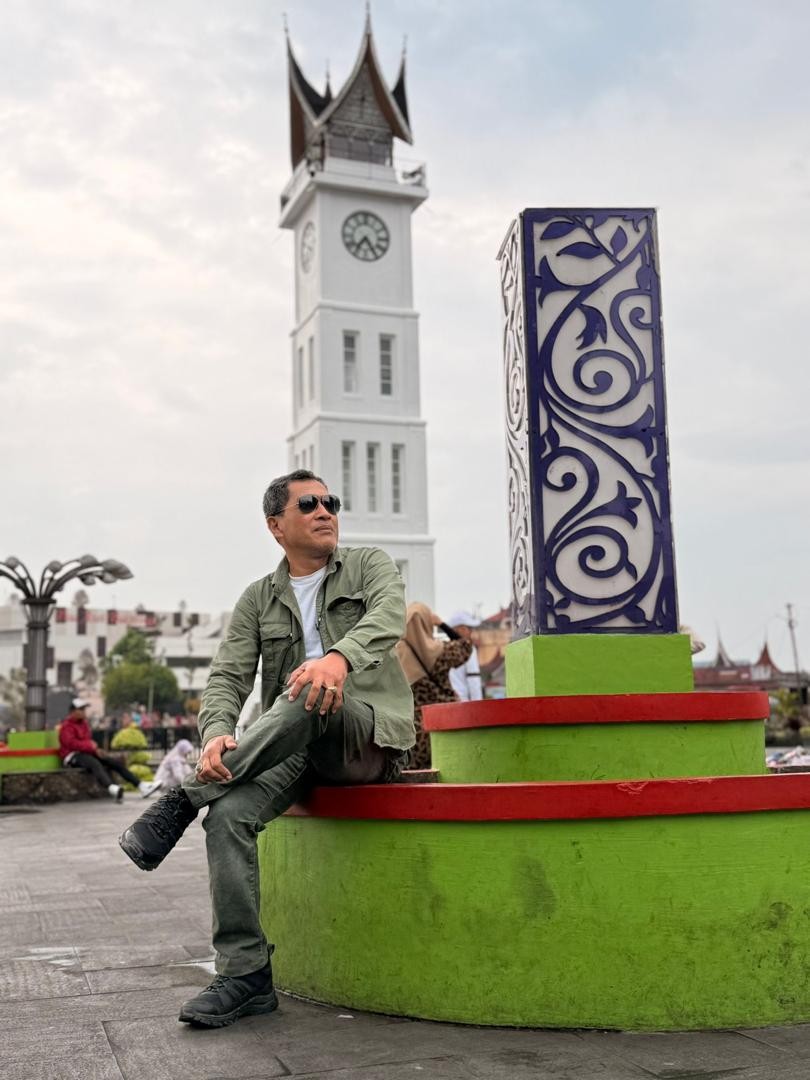
We arrived at Bukit Tinggi just as the sun was setting on the western horizon, but due to thick cumulus clouds above, we couldn't see the sunset. Anyway, I had already expected this, as the sky had been overcast all the way from Solok to this place. Shortly after, at Danau Singkarak, we were only able to watch the sun. Bukit Tinggi, situated in the hinterland of West Sumatra, is one of the most popular destinations on the island. Some consider it a shopping heaven in Sumatra Island, offering a variety of goods ranging from textiles and traditional crafts to gold jewellery and household appliances. Due to its favourable weather, which is cool and crisp, many from the lowland areas of Padang, as well as Pariaman, come here with their families during the weekends. Bukit Tinggi is also well-known for its historical sites, such as Lubang Japan, as well as the Museum of Minangkabau, which houses a variety of traditional items. The most notable feature of all is its icon, Jam Gadang, located at the summit of the hill. The large clock, situated at the top of a white tower with a Minangkabau-style roof, is a favourite spot for visitors to take photos. If no pictures are taken with this clock tower, one would presume one has not arrived in Bukit Tinggi. Due to these reasons, it comes as no surprise that many people love to visit here, even for a short time.
Coffee was first introduced to Europe by the Ottomans during their height hundreds of years ago. The word "coffee" is actually derived from the Arabic word qahwa. Many years ago, coffee was readily prepared by mixing roasted and ground coffee beans with hot water and adding sugar or milk. Many went to coffee shops to enjoy their favourite coffee. Over time, coffee has become a big business, with tastes and flavours depending on how it is made. More often than not, brewing coffee plays a crucial role in this process. Now, café, which is a modern type of coffee shop, are mushrooming. The two types of coffee are: coffee-based drinks and milk-based coffee drinks. Cappuccino, flat white, and mocha are under the former category, while espresso and Americano fall into the latter. More often than not, I prefer a hot cappuccino when I visit a café. I personally prefer this type of coffee because of its balanced taste and texture, combining coffee and milk. Usually without sugar, as it is already sweet and creamy. The foam provides a pleasant mouthfeel that I enjoy the most. But for some people, you won't taste real coffee unless you drink coffee-based drinks. The bitterness of coffee is what they are addicted to. But I yet one of them.
The overall setup of Coffee Go café, situated between guesthouses on a small street in Bukit Tinggi, is excellent. Its main building, located at the end, provides more open spaces for customers with a well-arranged arrangement of tables and chairs. A concrete slab and granite gravel surface, combined with low- to medium-height plants in large vases, complemented by foldable garden umbrellas, provide shade for customers and are beautifully crafted. I fell in love with this café at first sight. What a feeling! Later, we enjoyed coffee and pieces of cake with some friends at the café. As usual, my choice was a cup of hot cappuccino. Shortly, the guy who took the order and operated the counter brought a ceramic cup of cappuccino. I was delighted when I saw its foam dusted with brown cocoa. As I preferred the sugarless version, my first sip was bitter, but it later softened with the creamy milk, so velvety that it clung to my lips. Luckily, I had a clean shave; if not, it would cling to my moustache and beard. What a drink! As it had just opened, we were among the early birds.
As for my generation and myself, we have no problem enjoying tea or coffee at a warung, coffee shop, or café, as we can easily adapt. On the contrary, for new generations who are brought up in the advancement of life with better use of technologies, where we were and now do things they could not easily accept. A few reasons we still enjoy Warung are that it is an open-concept shop, where there are no barriers, walls, or glass, and no separation between customers, allowing drinks and food to be prepared in the same space, especially in the morning, when you are sipping hot tea and coffee amid a crisp, fresh, cold morning breeze. Not to mention those who smoke, as it is an open space. But now smoking is no longer permissible in public areas, including at warung, even though it is an open-air eating space. Eating at a warung is also more affordable, as the prices of food, kueh, and drinks are generally lower.
For your information, there are three main markets in Bukit Tinggi: Pasar Atas, Pasar Bawah & Pasar Aur Kuning. Both Pasar Atas and Pasar Bawah are just a stone's throw from Jam Gadang. Synonymous with its name, Pasar Atas is actually situated at the upper level and Pasar Bawah below it, as it follows the lower slope of the hill. More often than not, after photo shoot visits usually go to both markets. You can buy a variety of souvenirs. Among others is the Tengkolok Minangkabau, also known as the Minangkabau headdress. It is a traditional headdress associated with the Minangkabau people. The Minangkabau version, unlike other Malay versions often referred to as Tengkuluk Tanduk, features a distinctive horned shape. Like us, the Minangkabau people don't wear this headdress every day, but only for special occasions, such as wedding ceremonies. Tourists buy it as a souvenir. Embroidery bags overhang a narrow lane; hardly do passersby notice them.
As for women, they have a wide variety of fashionable and brightly coloured clothes to choose from, ranging from Songket, which is traditionally woven in nearby areas, to embroidered fabrics for traditional clothes like baju kurung and kebaya. Haggling skills are helpful, but more often than not, vendors have their own floor or rock-bottom price. If you are unhappy with it, you can move away and find other shops. When it comes to shopping, women know the best. Usually, they walk from end to end of the complex's floors to find the best items; time seems to fly for them, but for their husbands, time passes very slowly. As many husbands as I prefer to wait in a coffee shop or a café, spending time reading and writing.
The following day, after breakfast, we walked to the Jam Gadang Tower, located in the centre of Bukit Tinggi's main public square. Life around the area was yet to stir. Unlike the previous day, when the place was packed with visitors and peddlers, the square was devoid of visitors except for a group of people who performed Zumba, exercising with the blasting sound of songs.
Suppose you are foodies, especially those who are particularly fond of traditional cuisine. In that case, you can visit Pasar Bawah and find many delicious options available, allowing you to take the time to enjoy them. Many Minangkabau foods are similar to our traditional Kelantanese cuisine. Etok is also consumed here, but not in the same way as etok salai; it is cooked in a coconut-based gravy. Other foods include a variety of glutinous-based cakes, as well as powdered rice-based cakes sprinkled with coconut brown sugar and topped with grated coconut. What has been mentioned here is the tip of the iceberg of traditional Malay cakes, or kuih, which is so much more out there waiting to be discovered. Here, food and traditional cakes are still preserved, and they will remain a part of the culture.
While people said the past is another country, here you can revisit your past and rekindle those years. For those born in the 1960s and 1970s, markets, not supermarkets or malls, were places we were familiar with, as fish, prawns, and meat were bought and consumed daily, and there were no fridges to store raw ingredients and food. A market was a magnet for business activities, and social life revolved around it. At present, due to the onslaught of modernisation, some traditional Malay cakes are gradually disappearing, whether we realise it or not. Perhaps new ways of preparing and presenting them can revive the products to suit the present customers' expectations, and at the same time, providers can earn profits from the businesses.
I noticed the presence of peddlers with a wide range of goods, taking advantage of the opportunity to earn profits when many people gather around the grand clock area. A few of them sell sparkling and colourful balloons, walking here and there, approaching parents or a group with kids, as they know very well that kids love playing with them. In the dark, they were more tempting for kids as they glittered. If you're thirsty, drinks can be bought from peddlers around the corner, even for cold beverages. We purchased some boiled bananas, which were a little bit different in our place, as they had a brown colour. We found a special leaf inside the plastic bag of bananas. This leaf, whose name we didn't know, had turned the banana peel's colour. It tastes slightly different, as the leaf's flavour blends well with bananas.
The word Gadang in Minang means Big. When we refer to Rumah Gadang, it means a Big House, and Jam Gadang refers to the large clock. The Jam Gadang clock tower, which stands 26 meters or 85 feet tall, is a landmark of Bukit Tinggi. This white colour clock tower is the most popular building in Bukit Tinggi, as visitors take their pictures with it. It is also popular as a souvenir, and you can choose to buy either a miniature of the clock or a fridge magnet. We usually prefer the latter as we are collectors of fridge magnets. In every country or city, we visited, we tried to find one to stick on our fridge door in the kitchen.
It is interesting to note that this clock tower has been modified and reconstructed several times due to various factors, including changes in administration and an earthquake that struck Bukit Tinggi in the past. During the Japanese occupation of West Sumatra from 1942 to 1945, the roof was altered from its original Dutch design in 1926 to resemble a Japanese pagoda roof, where the original rooster figure was replaced with a Sōrin spire, a feature common in Japanese Shinto architecture. Later, when Indonesia gained independence in 1945, the roof changed to the distinctive horn-shaped roof of Minangkabau. While the earthquake flattened Padang in 2009, the damage to buildings as well as the clock tower was relatively low. This clock tower has been reinforced to withstand earthquakes.
We promised to meet at midday near the Jam Gadang, and agreed on 2 hours for shopping. After the hours, not all showed up. The evening stole up on us, besieged by hunger, we went to the Nasi Kapau restaurant in Negeri Kapau. We passed a lovely village surrounded by rice fields.
Since both Nasi Padang and Nasi Kapau originate from the same place, West Sumatra, and those who cook them are Minangkabau people, you may wonder what the difference between them is. After briefly observing both foods, I noticed a few notable differences. Firstly, the way the food is prepared. As for Nasi Padang, the dishes are displayed vertically, creating a few pyramids, with one food container stacked on top of another. As for Nasi Kapau, there is no such thing. Dishes are arranged on the table individually, and some dishes will be placed higher accordingly, based on different platforms or levels, but they are not stacked together. This arrangement pertains to the preparation of both types of rice for customers. As for the former, many dishes, up to 25 on the menu, are arranged on a table, and customers can choose which ones they want to eat. Only those that are eaten count.
As for the latter, more often than not, all dishes are placed together on a plate with rice. Those who serve the rice are seated in a higher position and use a long wooden spoon to scoop selected items for customers onto a plate. On the contrary, there are different types of dishes. As for Nasi Kapau Gulai Tembusu, which contains eggs and tofu stuffed inside a cow's stomach or beef tripe, it is a consistently popular dish, but I have yet to come across it in any Nasi Padang restaurant. Another dish you can find on the Nasi Kapau menu is Gulai Ikan Mas, also known as Goldfish curry, which is not typically prepared for Nasi Padang. Lastly, Nasi Kapau is prepared and cooked by those from Nagari Kapau, as they are well-versed in traditional cooking and dish preparation. As for Nasi Padang, not necessarily those who cook it come from Padang, the capital province of West Sumatra.
Many, including myself, are familiar with Nasi Padang, so the first thing we usually do when arriving in Padang is to go to a restaurant that serves it. For those who visit Bukit Tinggi, Nasi Kapau should not be missed. You can find it at Pasar Bawah, just a few minutes walk from Jam Gadang. However, we went to the place where the name of this rice originates - Nagari Kapau. Just under 4 km, this place is approximately 15 minutes from Bukit Tinggi. And when you arrived there, the Nagari Kapau arch would greet you. This village is surrounded by rice fields, where the source of rice for Nasi Kapau is. The one we chose was a humble, red-tin-roofed wooden food shop situated by the roadside in the village. Despite its unassuming appearance, the food served here was fantastic and sumptuous, with a wide selection of dishes presented in large steel bowls, neatly arranged on the table. As a visitor who would be lucky to be here and not knowing when you would return, you seemed to want to try everything, from gulai Ikan Emas to gulai urat, beef rendang, and fried chicken with bumbu or spices. The weirdest thing is gulai tembusu, where the cow's stomach is filled with egg and tofu or bean curd. It is common to eat this rice with crackers. Small metal bowls were provided for washing hands.